
|
 |
 
|
Beginner to Advanced
Advanced beginner, intermediate and advanced skill workshop
All levels
Advanced Beginner through Advanced
Advanced Beginner through Advanced
Advanced Beginner through Advanced
Beginner to intermediate skill workshop
Advanced beginner, intermediate and advanced skill workshop
Beginner to intermediate skill workshop
Intermediate to advanced skill workshop
Intermediate to advanced skill workshop
SUNSTAR©: A Two Day Kaleidoscope Class
Maximum: 20 students
Recommended Format:
2 day workshop
Price:
$825/day
Students learn all of the unique machine piecing and template techniques I use to create complex kaleidoscopic images while simultaneously exploring the virtues of bilaterally symmetrical fabric. You’ll learn to draft perfect angles and to identify and join different angles together. This product and process class culminates in the creation of a unique and fabulous kaleidoscope block. Often effects more wonderful than you imagine occur, making you both the one who makes the magic and the one who is surprised.
Day 1: No sewing machines
Day 2: Sewing machines needed
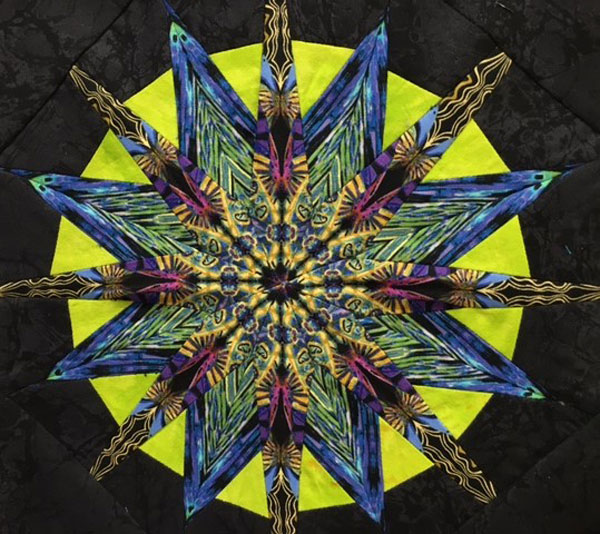

Classwork by Ricki Selva
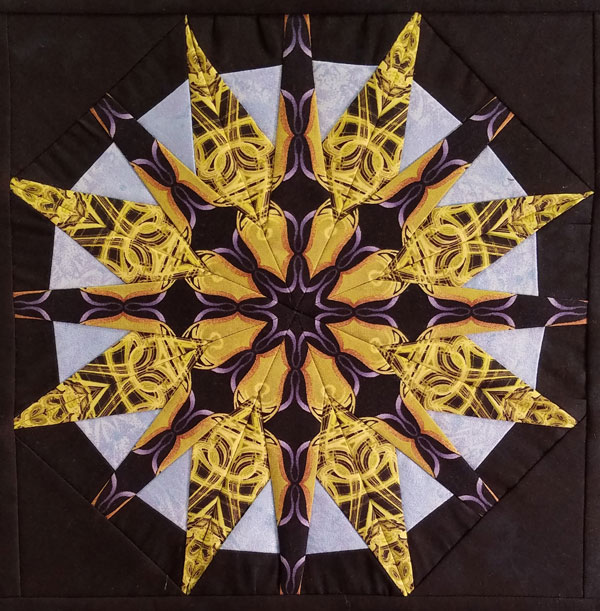
Classwork by Helle-May Cheney

Classwork from Frenchtown, NJ workshop
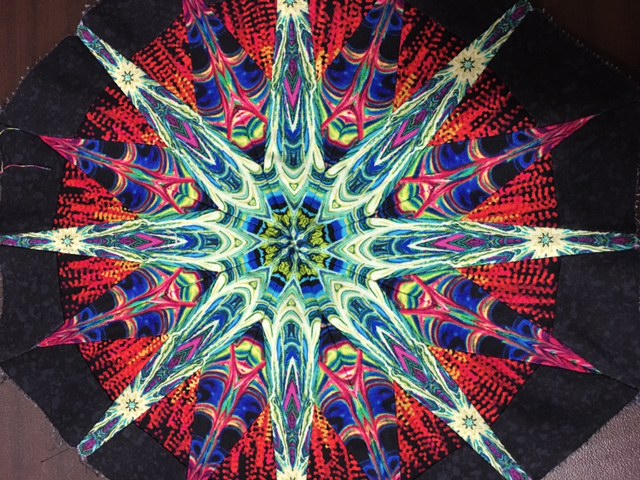
Classwork by Cindy Fitzgerald from Bayshore, MI workshop
When possible, Paula Nadelstern fabric will be available for sale in class. Unusual, hard to find supplies on the following list are marked with an asterisk and will be available for sale in class: template plastic package, ruler, and efficient marking pens for templates and dark fabric. If a kit is offered for your venue, the items with an asterik will be provided in the kit.
|
1. Graph paper with an eight-to-the-inch grid and a bold inch line; one sheet per student will be provided by instructor. |
|
*2. Package of see-thru plastic template material with an eight-to-the-inch grid and a bold inch line. PREFERRED AND AVAILABLE FOR SALE IN CLASS : Visi-Grid (C&T Publisher) |
|
3. Thin rulers (PREFERRED AND AVAILABLE FOR SALE IN CLASS: C-Thru 6") |
|
*6. Extra fine-point permanent marker. (PREFERRED AND AVAILABLE FOR SALE IN CLASS: Multimark S/Faber Castell in |
|
*7. Method to mark dark fabric. *PREFERRED AND AVAILABLE FOR SALE IN CLASS: Uniball Silver Gel Pen) |
|
8. Fabric scissor |
|
9 Template/paper scissors: A template scissor should not be the discarded kitchen shears or shaped for a five-year-old's hand. It is the essential, indispensable tool from which all other acts follow. I use OlfasCS-1 multipurpose scissors. |
|
10. Set-up for rotary cutting, including a rotary cutter, ruler and mat. OPTIONAL: Small rotary cutter and Brooklyn Revolver (cutting mat mounted on a lazy susan) |
|
11. Sewing machine with well-defined quarter-inch seam allowance guide + single hole throat plate |
|
12. General sewing supplies including black thread and extra fine pins (Recommended: Clover Fine Patchwork Pins) |
|
13. Ziplock baggies to hold templates |
Fabric (When possible, Paula Nadelstern fabric will be available for sale in class)
The success of SUNSTAR depends on choosing 2 bilaterally symmetrical fabrics. A motif with bilateral symmetry can be divided into identical halves by a line passing through the center. Fabrics 1 + 2 should have an apparent relationship but should not be matchy-matchy.
Fabric 3 functions like a circle behind the kaleidoscope. Pieced from an allover fabric, it should contrast sharply, even clash, with Fabrics 1 + 2 in order to stand out and emphasize the shape of the “sun” (although it does not have to be a bright sunshiny color). It is best to audition Patch 3 in class so bring a variety of small to medium all-over prints (not solids) evoking luminosity or translucence, textures, gradations, splattered dots, speckled stuff.
Patch 4 functions as the background and is often a dark, rich saturated, reads-like-a-solid-but-isn’t fabric such as a tonal black.
|
Yardage Requirements for a Single Block Made in Class 10" x 10" |
|
|
Fabric 1: Bilaterally Symmetrical Fabric: |
1 yard or eight repeats |
|
Fabric 3: The Sun (all over fabric with high contrast from Fabrics 1 and 2) |
1/2 yard |
|
Fabric 4: Background (typically saturated dark tonal or black on black |
1/2 yard |
|
|
|
|